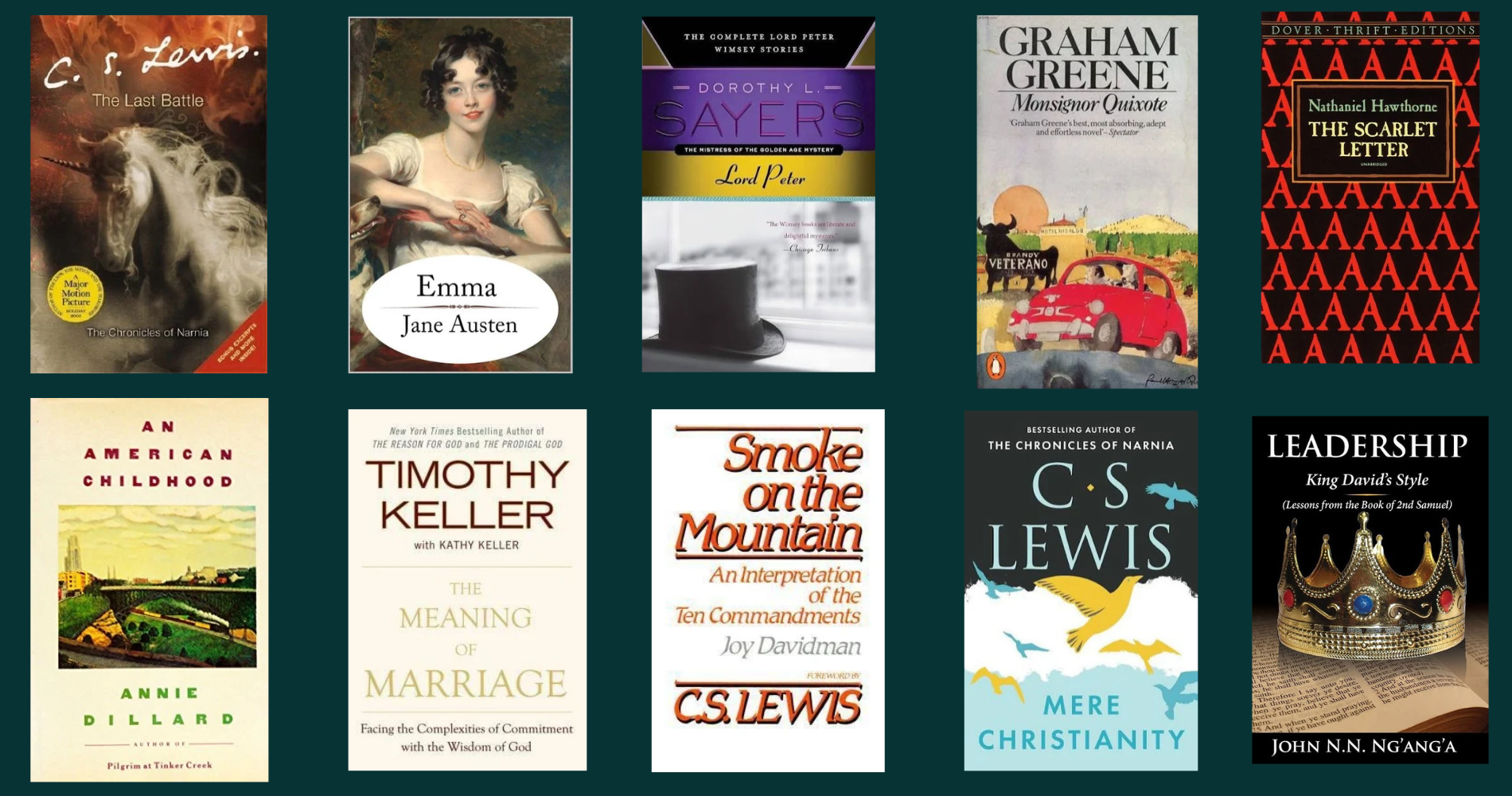
Yes, here’s another particularly ambitious reading list for, of all people, a medical student. And of course an insufferable essay to accompany it.
I think myself to be not so much in danger of reading a lot as I am of reading too little. Though, and justifiably so, the worry might be whether I really will pay due attention to my medical training, and academic reading, I am quite certain by now that if I read or do so little of medicine, it isn’t because I read to much C. S. Lewis but because I was distracted, usually with social media, and invested in very trivial matters that suddenly made the time seem like it had flown away. I am yet to find the balance, if I ever will, but I hold to a firm belief that even a serious medical student, and later a medical doctor, can still keep up a healthy, fulfilling, and challenging literary life. This seems to be the auspicious time to train myself to be a reader, though I have wished that I had had an early start in my first year, or even in my high school days.
I know that I have read some books too fast, Thomas Browne’s Religio Medici and Urne-Buriall for example, and I have often urged myself along just so to get through my list. I could of course dispense with the list altogether, and read on such strict terms as by whim alone, but I cannot trust my discipline and enthusiasm so much as to commit something as important and imperative as my reading to them. There have been times when I would not have read had there not loomed over me the shadow of the approaching deadline; the dreadful end month. Though dreadful in that regard, the ending of one month has always promised the dawning of a new one, and every month has meant a fresh reading list, even if some of the titles are rereads, as indeed several of October ‘26’s are. There is a pleasure that comes with listing all the books one hopes to read, or, embarrassedly, one hopes to have read. Mr. Knightley, speaking to Mrs. Weston, faults Emma’s habit of always making lists of books to read, and yet never reading them at all for being unable to apply herself to anything requiring industry and patience. The making of lists, precisely because of it’s being so pleasurable, risks being done for it’s own sake. And if the list is public, as mine are, one might do it to seek, whether unconsciously or not, the approval, approbation, and admiration of others.
However gladdening and fulfilling reading is at some moments, and how rewarding it usually feels in retrospect, the habit of sitting down alone for long hours poring over pages or gazing at a screen if the book’s an epub or pdf is one that is bound to be depressing and sometimes even harrowing. I have, with time, been able to, I think mostly accurately, come to know that my gloominess and misery to be the result of me being hypoglycaemic, or broke, or just feeling purposeless as one is bound to feel at some points in their lives, especially, I think, if they happen to be a medical student in this very competitive and highly ambitious space; but I am also nodding vigorously when I reflect on the the Preacher’s words in Ecclesiastes when he warns that much study is weariness to the flesh. Much reading, despite its proved benefits, often exacts a toll on those who apply themselves to it for staggeringly extended hours. I shouldn’t have been surprised (I was) that Annie Dillard would read for as much as 12-16 hours in a single day. I have wondered if that is even humanly possible; to spend more than half a day with and in books. But so much reading is the price that is to be paid if one is ever to write such books like the ones Annie Dillard and C. S. Lewis wrote, and like those that Jonathan Franzen is writing.
My counsel to anyone who aspires to read as much as I do, or even more than I do, and yet fears that that commitment will get in the way of his tasks and responsibilities, is for him to go ahead and draw up a list and start reading. Later, one doesn’t regret that he read too much but that he read too little. Grey hairs, much more tasks and responsibilities and too little time, a failing mind, failing eyes, and declining health are all part of the package that awaits us as the years pass, and it’s a package we have no option of refusing. Some people have very genuine reasons, and saddening too, for being unable to read; terrible eyes, severe ADHD, busy and all-day-engaging jobs. Most of us cannot say the same, or shouldn’t. We just need a little(or hard) nudge and encouragement— to put away our phones, to stop becrying our fried brains and do begin to do something about it, to jettison TikTok and Instagram, to dare pick up a book and sit with it for half an hour. “For though a day (or an hour) spent reading might not be a good day, yet a life spent reading is a good life.” And what better person to have said that than Annie Dillard herself? Rest in peace Annie Dillard.
And so, to return to my list of books I mean to be reading in October 2026, there is:
- Leadership:King David’s Style by John Ng’ang’a
- Smoke on the Mountain by Joy Davidman Lewis
- The Last Battle by C. S. Lewis
- An American Childhood by Annie Dillard
- The Complete Lord Peter Wimsey Stories by Dorothy L. Sayers
- Emma by Jane Austen - The current Philokalia Club read-along.
- Monsignor Quixote by Graham Greene - Novel of the month
- Mere Christianity by C. S. Lewis - Current Medical School Christian Union Book Club read. I am rereading it.
- The Scarlet Letter - Catherine Project Course. Rereading.
- The Meaning of Marriage by Timothy Keller - Reading and discussing it with my best friend.
- Turning Points: Decisive Moments in the History of Christianity by Mark Noll - Tree and Fruit Bible Study text
Rather than give my reasons in so bloated and tiring sentences and passages here as I have done before, I mean to do so separately through individual and (hopefully)pithy essays. I am, however, in doubt if I’ll do so for, or even have so much to say about, half the books. I am not sure if it’s a wise thing to say, at least not yet, but I am slowly getting convinced, and convincing myself, that if one has just an hour to spare, and means to read and write, he should read for 60 minutes, and write the next day when he’ll have more time. To quote and lean on Anne Lamott as my defence, here’s what she tells her students in Bird by Bird, trying to lead them out of their obsession with wanting to get published:
…in the meantime, we are going to concentrate on writing itself, on how to become a better writer, because, for one thing, becoming a better writer is going to help you become a better reader, and that is the real payoff. (emphasis mine)
It’s a well known fact that writers are as good as what they read, and writers are always encouraged to read well because then they’ll write well, but who expected that writing itself is important so far as it enables us to be better readers? That we learn to write well, so that we can read well?
Interestingly, here are three books I had to take off the list; mostly to keep the list modest and because there really wouldn’t have been enough time to read them too. Maybe November. Or maybe not.
- The Hours by Michael Cunningham - This was supposed to be a follow-up to Virginia Woolf’s Mrs. Dalloway
- The Psychology of Money by Morgan Housel - It is high-time I began making an effort to be less ignorant and illiterate with regards to finances
- The Psychology of Effective Studying by Paul Penn - I know it’s late, and that I have gotten so far already with so little help and knowledge of what effectively works, but I know (and hope) too that I still have years of studying ahead of me, and it would be rather foolish to continue doing it shittily still when there’s a chance to do it in a much better and effective way.
All the best in your own reading. Of course I will appreciate companions for any title.